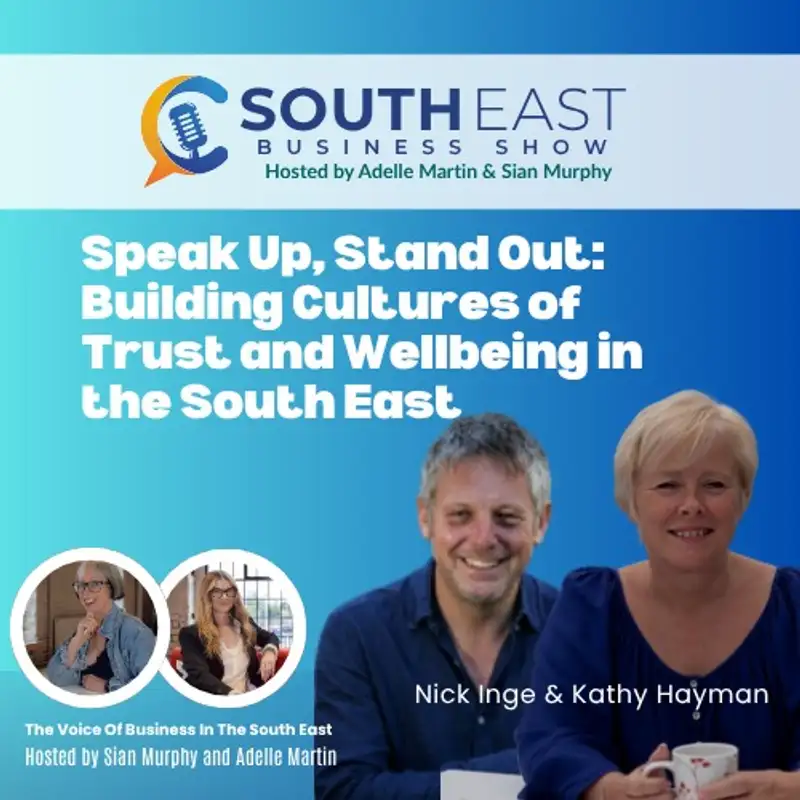
Hello, and welcome into the South East Business Show. I'm Sian Murphy, my co host is
Adelle:And I'm Adelle Martin. And before we
Sian:get going, I just wanna give a shout out to our sponsor, Women's Fearless Coaching. So thank you so much to these guys for keeping us on air and giving us a really good time because what we are is the voice of business in the South East. And along those lines, we're welcoming into the studio today, Nick Inge, who is the owner of iTrust. Welcome, Nick.
Nick:Thank you very much for having me. Nice to see you all.
Sian:And we also have Kathy Hayman. Now, Kathy, Kathy is a return visitor, not on the South East Business Show, but you've been in the onto the Women in Business Radio Show on more than one occasion,
Kathy:haven't Indeed. Thank you for inviting me along.
Sian:And Kathy, you are evolving and you are, you're evolving. I've seen you sort of go through several iterations of what you're doing, but all along a very similar theme, isn't it? You haven't gone from sort of manufacturing tires to go and working in wellness. No. Haven't.
Sian:So Kathy Kathy is a mindset coach, she's an NLP practitioner and the founder of Better Minds Better Business Limited. So welcome into the studio and that's sort of a newish project for you, isn't it?
Kathy:Oh, yeah. In the last So
Sian:I think what we're gonna do, we're gonna be talking about business in the South East. We're gonna be talking about some funding opportunities, some events, and we're gonna be getting the opinions to take the views of Nick and Cathy on what it's like to actually be a business owner in the South East. But first of all, what I'd like to do is to find out what they do and who they do it with. And I think we're gonna start with Cathy. So Cathy, tell us a little bit tell us a little bit about your story and how you've ended up doing what you're doing.
Kathy:Okay. So could be here a while. I'll give you the headlines.
Sian:Yeah. Mean, it's true. If you start up when you were born, it's gonna I don't want to blame you on doing
Kathy:that. Just
Sian:give a week. It is going to take quite a while. We're going to keep an eye on Nick, if he starts sort of, you know, elbowing you. You Obviously snoring in the background. Move it along.
Kathy:Okay. So the previous iteration of this business was to provide tools and resources to people around mindset and well-being. And that business was really aimed at individuals. The new iteration of that business through a journey that was quite interesting. We're now in a place where that's evolved into providing support to small business owners and their teams, which is actually when I look back on it, and you know what it's like, looking back is great, isn't it?
Kathy:It's actually the place that I really wanted to be, and I'm really glad that we've got to this point, you know. But everything that happened had to happen to get us to where we are.
Sian:It's odd how that works, isn't it? That you think you're doing one thing and actually you're doing something totally different. And it takes a while for sort of you in the universe to catch up and realize what it is. Yeah. So tell us a bit about how you work with businesses and their teams now.
Sian:So what what does that process look like?
Kathy:So what we create is a membership program and it covers four different major aspects. So the first thing is about the legal side of business owners that employ staff having a legal obligation to look after them from a well-being perspective. A lot of small businesses that figure something like 75% don't know they have to do this. And they don't have in place that workplace stress risk assessment that they legally have to have.
Sian:And it isn't Sorry to interrupt you, but it's gonna happen a lot. So I'm gonna I'm gonna this is like one sorry. Okay. Covers the whole show. Yeah, of you by the Yeah, whole show and the rest of your life, okay?
Sian:It ain't gonna happen again. I forgot what I was gonna ask now. It was is is there some legal obligation to actually do this sort of workplace stress assessment, all of this sort of risk assessments, that sort of thing. It does that kick in a particular number of people that you're employing? Does it I haven't finished.
Sian:Hang on. Does it apply? You can you can answer these sequentially if you like. Does it apply to volunteers or do so do you have to be actually employing people in the legal sense of the term employing people? Can it include freelancers and does it include volunteers?
Kathy:Okay. So the legal obligation is for actual employees and it starts with just one. Under five, you don't have to have it written down, but there is a strong recommendation from the HSE Health and Safety Executive that you do write
Sian:it down. So it sort of fits in alongside the Health and Safety at Work Act. Yes. With the legal obligations that you might have under a health and safety policy. You have to keep every you have to have safe processes, but you don't necessarily have to have documented a policy until you hit that five Can of over
Kathy:I ask a question?
Adelle:Is that for employed people or say for instance you run a business model where you employ nobody, but you have contractors that you revolve in and out. Do you need it for the contractors? Or is it just employed?
Kathy:No. Just for employed people because I guess from a contractor's perspective, that's up to them to put that just in place for them. Checking
Adelle:because some small businesses haven't got the funds to employ people, but would have contractors because it's more flexible.
Kathy:Yes, absolutely.
Sian:Although I think you might actually have a legal obligation as somebody who's taking on a contractor or subcontractor to actually make sure that their health and safety practices and procedures are up to scratch.
Kathy:Yeah, so from the perspective of ISO for example, there's some changes coming in in the ISOs later this year and early next year. They're upgrading them and they're going to be including more about culture and well-being into them. Now if you are, let's say you're a major construction contractor and you have other smaller contractors that tender for business from you, typically you would want them to adhere to the same ISOs that you have to. So therefore it does affect the smaller businesses down the line. A lot people think I don't need this because I'm a small business.
Kathy:I employ five, ten people. But actually you do.
Sian:Yeah. So how would let's assume we've got somebody set out there at the moment. They're employing four people. They're thinking of going to five, six, may just have one. How can they how can they connect with what you're offering to find out what their legal obligation is?
Kathy:So we have a website, betterminds, betterbusiness.co.uk. Couldn't get that out. So easy to go to the website or to contact me at hello app. And the the risk assessment side of it is just the first bit. So you have to do that.
Sian:But
Kathy:for me, it's not just about saying we've ticked a box. And it isn't for that either from the HSC's perspective. So if they come in and do an investigation, they don't care that you've just got a piece of paper. They want to know that you actually have practices practices in place and things that will support support your staff. And for me, it's not just about the staff either.
Kathy:I've been a small business owner in various different guises for more years than I wanna tell you. And it's tough. It can be really hard running a business. And we feel like we have to wear all the hats. We have to be responsible for everything.
Kathy:We have to look after everybody. And we need that support because if we don't look after ourselves, how can we look after other people? So there's lots of other tools and resources available within the membership that support that ticking the box exercise.
Sian:So where you're at at the moment, there's an app. What supports individuals with their welfare? So we've we've dealt with the legalities of it. What about the actual people themselves with their health What and sort of support can you offer them?
Kathy:Okay. So when when a business joins up as a membership, all of their staff have access to our online portal. It's not an app in the strict sense of the word, but it's a membership portal that they can log into. And within there, there is a whole host of tools and resources. So there's a section for business owners which their staff wouldn't necessarily have access to, but it's that's supporting And them as a business it's videos and PDFs and all sorts of different resources.
Kathy:And then the same for the individuals. And it's around things like, you know, managing stress, recognising when you're stressed rather than just having a bad day and you know, all of those kind of things. Lots and lots of tools and resources for them. And then alongside that, there's access to our professional support providers. So I think we're currently at 31 of those, many of whom you all know.
Kathy:They're people that can provide that one to one support.
Sian:Are they all my chums?
Kathy:Well, I'd like to think so. So that's around coaching, counselling, any type of therapy. So anything that's on a one to one basis that anyone within a business might need. So can I give you a bit of a story of something that happened a conversation?
Sian:Just check check that. Hang on a minute. Yeah. Go on. Go on.
Kathy:So I was talking to a guy the other day, and he's got a team of 10 people. Two of them are sadly going through very difficult divorce situations. Thankfully, not to each other.
Sian:Oh, yeah. We've got a separate Now, office
Kathy:one of them is a lady who is so upset at the moment that she can't stop crying and she can't come to work. The other one is a guy who wants to come into work and talk to everybody about what's going on in his life.
Sian:Yes. And he wants
Kathy:to sit down with the boss and get his advice and opinions.
Sian:Oh my goodness. Yes.
Kathy:And the guy is saying to me, I am so stressed. I don't have the tools and resources, the skills, the to deal with this stuff. I wanna support them, I just don't know how. So that is a prime example of someone that within their membership could say, there's a divorce coach, Go and connect with them. And it can be done confidentially from the individual's point of view, and they can access it, pay for it themselves, get access to the, discounts that are available to them, or it can be done through the business.
Kathy:So the business owner could say, look, I'll pay for this or I'll subsidise it. And that goes across a range of all sorts of different areas that we might experience stress in. And then the fourth side of it is the training side. So you know those situations where someone's really great at the job and they go, oh, you can be a manager now. Yeah.
Kathy:And they put them in that position with no training and support and they can't do it.
Sian:It's two different things, isn't it? Completely different things. Do as a managers. Yeah.
Kathy:Do you wanna go and sell this for us then? Because you know all about it. Yeah. Be a salesperson. So we have training available for to cover all of those soft skills sides of the business as well.
Kathy:So lots of things included.
Sian:You have been on the journey, haven't you? But now now you're sort of we were talking about ticking boxes. You're almost ticking both of them, aren't you? Because you're still supporting the individuals. Absolutely.
Sian:You're just supporting, if we say individuals or business owners, you're now just supporting them in a much wider
Kathy:capacity. Absolutely.
Sian:Because not knowing all of this stuff, not knowing what you don't know can be just so stressful.
Kathy:Yeah. Yeah. Absolutely. It's been a real journey, but it's like I said, it's got me to the place where I really wanted to be because it's all the things I feel strongly about and passionate about.
Sian:Brilliant. And thank you for coming and sharing that journey with us. We're gonna ask Nick pretty much the same thing really, and then after that we're gonna go and have a bit of a general discussion about what's going on in the South East. And then come back to Cathy and Nick later on. So Nick, you've got an interesting journey as well, haven't you?
Nick:Well, some people might think I have.
Sian:Do. Okay, Nick.
Nick:Seamlessly into Nicky and he's talking about his life journey. Well, I was born in '19 no. Yeah. So I used to be in the police until I retired nearly seven years ago now. And and I set the business up iTrust as a dormant company in 2017, with half an hour going at 50 from the police when I retired from the police.
Sian:Did you know what you were gonna do? What it was gonna be about?
Nick:Well, it's gonna be a whistleblowing consultancy to start with, because I've got friends in businesses that I know through my son's football world. And I thought I had this idea about having a business, and what did I know about business? I was in public service and whatever, and a friend of mine who's still got a business locally in Kent said, do you need a whistleblowing consultancy? What's that? You know?
Nick:And that's how it just evolved from there. And now we've a software business. So things change in pivot in business as we know, and things develop, and here we are. So yeah. So there is a bit of a story in between where I am now and how that happened, if you want
Sian:to I hear thought they might. And I will ask that. Yeah. It's a different type of businesses, isn't it? I come across so many people in business and doing, and very often they're doing actually very similar things just in different ways.
Sian:I have not come across a whistleblowing company. So I am gonna be really quite nosy here. Was there something in your past experience that actually got you to say, do you know, this is something that we really people need this, we need this.
Nick:Yeah. Well, there's a few points there. Where the where the reason you haven't heard about it is because we're the only people in the world doing what we're doing. It's not a whistleblowing consultancy, It's a feedback software platform which is evolved in from a whistleblowing consultancy. And the story is, I used to be, please, like I said, spent most of my service recruiting informants, criminal whistleblowers, all sorts of different levels in The UK and abroad.
Nick:And I could see that skill set being taken into initially the sporting world to allow parents to speak up on the touchline at football clubs where maybe they hadn't got a voice or a mechanism to report stuff at grassroots sports level. Because Louis, my son, used to play football from the time he could crawl through to the time he was, you know, on the books at Palace at one at Crystal Palace at one point. So I as a football dad and a football fan, I was still on the touch line listening to all the nonsense. Yeah. And there was no reported mechanism for this to happen.
Nick:So I thought, if we can keep criminal whistleblower safe, how can I do that in the sporting world, I'm the classrooms
Sian:just going to ask this because I haven't I have not been a football mom?
Nick:Okay.
Sian:I have boys. Fortunately, they didn't like football, which is just as well because I would not have been there on a Sunday morning in the freezing cold watching this. Yeah. But what sort of things we're talking about that you're hearing? Is it sort of abuse of a child?
Sian:Is it unfair, unfair refereeing? Is it the potential for far worse abuse that's going on behind closed doors? All of those.
Adelle:I was a gymnast from three to 15, so you can only imagine
Sian:what I'm I not a sportive sort of, I don't do that sort of thing, I try not to move
Adelle:So I too love what you've
Sian:used So what is the sort of thing that you've seen? All of
Nick:of that. And all of that and worse, as well as there wasn't a reported mechanism for the good stuff as well, because there's plenty of brilliant stuff that goes on. Right. Okay. Then you can see how the story is morphing from whistleblowing Yeah.
Nick:Which is all about the app which is about the negative Yeah. To all the brilliant stuff. So this is feedback in every single sense. So what happened was I retired in June 2019 for the police, started running a hotline on my mobile phone for parents at a football club in Maidstone where I live. And parents were leaving messages on the answer machine, and I was writing the equivalent of a police intelligence report and sending it into the club.
Nick:For things like, for example, people parking in disability based when they shouldn't be, coaches not coaching under the ethos of club. And, yeah, that's what happened. Parents started leaving messages on Marks Machine. I wrote the report and went into the club. Because there was no reported mechanism for people to do that ordinarily into the club because no one wants to be a grassroots niche.
Nick:Yeah. And if they do put the head above the parapet, generally what happens is their son or daughter gets dropped from the team. Yeah. Or what happens is they then move their son or daughter to another club because they don't wanna be having that confrontation. And then friends of mine so this is in October 2019.
Nick:It went very well. And then friends of mine who got some very successful businesses in Kent said, look, why don't you create a software platform where people can only speak up? Forget the whistleblowing word. That's all about grass and snitching. But they can praise, they can suggest, they can report health and safety issue, they can have a survey all in one place.
Nick:And we thought, well, that's a great idea. Because so hence, what you said about not knowing about this, no one else is doing this, because no one else is doing it. Because we've just been listening to businesses and said, listen, what do you want? And we'll create it. And that's what's happened.
Nick:And I'm not a techie. Honestly, I'm probably still logged on in Kent Police somewhere. I'm rubbish. I was one of these people who goes back from Andrew Lee and go, oh, forgot my password on the help desk. But honestly, that's the basic, very basic level of obviously, it's developed a bit now.
Nick:But that's the base level. And then what happened was going into the first lockdown via LinkedIn, we connected with a company called Verizio, who are now a client, but they're a modern day slavery management company. And they look after the likes of Dunelm and Travis Perkins and the white company, and they said, look, if you can create a software platform which is QR code enabled, that could be a game changer for their industry because someone could be the, say, the victim of modern day slavery in Vietnam. They could they could scan a QR code on the back of a toilet door and a poster, and a PDF could go in their inbox into Peterborough. And that's where that idea came from.
Nick:Oh, that's great idea. So and that's what we've done. We just created this platform. So it's feedback in every sense in one place. It seems a bit obvious.
Nick:Why wouldn't anyone be doing it? But like I said, it's morphed out of being asked to do it by different businesses who are now clients.
Sian:So at the moment, you you started off almost being the go between where people would be ringing you, you'd be creating a report which you then send off. Yeah. Are you you're now is is the process now people do, if you like, the reporting processes, they report it into your website, your app, and it goes straight through. And then it's filtered out to the company that that is being report I'm not doing very well here, am I? That's being reported on.
Sian:There isn't somebody in between sort of gatekeeping and and writing those words down. It just goes through.
Nick:Yeah. Absolutely. Yeah. So they've got it spot on. So basically, it's easy to access for our QR code.
Nick:It's easy to use. It's why, what, when, where, and how, which is my old world of policing. It's timely. So that's the point. It goes straight as a PDF in the inbox of the client, which is not just about the negative, about the positive and the change and everything else.
Nick:And so, yeah, like you said, we were the third party originally. But we thought, well, why would you want do that? We might as well send it straight through to the client.
Sian:Because then there's another level of interpretation, isn't there? And judgment and staff and yes, timely in those Yeah.
Nick:As we go straight through to the client. So the user could be a stakeholder. That could be a member of staff or a client or anyone associated with the business. They could be anywhere in the world, and they can report stuff 20365. So they could be on holiday in on a cruise around the Mediterranean, for example.
Nick:They might see something that's a great idea. And then they go, do you know what? And I'll send it through to my workplace because it could help the business or whatever. So it's and because of that, it's getting us across the line in terms of lots of different clients and
Sian:small businesses. Has so many not interpretations, interpretations, but but it it has has so so many many ways of it being used.
Nick:Yeah. Absolutely. So we basically, and this is not being cocky, certainly not, but we've got a product that goes across every industry across the globe, and there's not many people saying that.
Sian:And so for the modern slavery as well, she says thinking out loud, you know, that people make these statements, don't they? They have modern slavery statements at the So bottom of their what you enable them to do is actually, I suppose, walk the walk and say, yes, we do have we we have this policy, and this is what we do about it. And we make sure that if there is, you know, if if there is a factory or there's a workshop in the back of beyond wherever, you know, everybody can get this cure, they everybody, whoever they are, wherever they are has a routine and it's a really simple route.
Nick:Yeah, it's a proof point. If you look at our socials right, which is as opposed to greenwashing. Because lots of organizations talk a good job about we have a policy about whatever it might be. However, where where is the proof in terms of what they're doing? And there's a big difference between saying something and actually doing something.
Nick:And this is a proof point, as well as what we've done is over the last couple of years is create an ITRUST certification logo. So it's turned into something like an ISO or a kite mark. So so and Kathy's got it in in her business where, you know, when people see it, they think they know that this is a visualization of what this company is all about. They're they're honest and open and they've got integrity. And they're willing to hear feedback, good band and different 274-7365.
Nick:And for lots of businesses, it's a selling point in terms of their supply chain, their stakeholders, their staff. Because people want to come and work for them because they go, you know what? This business wants to hear my voice. Whether they do something about it or not is another matter. But I always said right from the outset, and I'm very driven in life, I'm very principled as well.
Nick:I don't want to work with clients that don't believe in the system because I'm just wasting their time and their money. And ultimately, if the user puts a report in, the client does nothing about it, we're wasting everyone's time. And the user is going to think, what's the point?
Sian:That's worse, isn't it?
Nick:It's terrible, isn't it? So yeah, so we always encourage our clients to say, when one of our clients is a big educational establishment in York, I said more than that, you could probably get to that to be honest anyway. But they have a you say we did policy. So every half term, they say to their staff, we've had x amount of reports. You said this, we've done that.
Nick:And if we haven't done that, this is the reason why because we can't afford it or So we haven't got the time to do it's really powerful. It's morphed into something more than ever thought it would be. Yeah.
Adelle:So for me, listening to both of your businesses, I spent 32 years in a very large global bank, the last twelve in HR. And we did what both of you are doing because we had the resources to do it. And then obviously I've spent the last seven years because I left the same time as Unique and that's why I've watched your journey and watch it. And small businesses don't have access to that. So what you two have done is plugged a huge gap and having that opportunity.
Adelle:But for me watching, because I still vividly remember, I hadn't quite left the bank and I was sneaking onto network meetings, just getting proof I can do this. And then something happened and I just left. But seeing how your business has grown organically and pivoted on that whole transparency, Nick, it's been amazing to watch, but it gives all of us that transparency because like culture washing or green washing or carbon washing, what's said on the website is not necessarily what is felt in the world. And what you do, you give people an opportunity to share truth. And I just think it's amazing.
Nick:Oh, thank you. Yes, it's a journey like any businesses, isn't it? And we're growing still and we're not in a bad place. But we've got small businesses. We've got solopreneurs through to big, very big clients.
Nick:Yeah. And they all use it for different reasons. Yeah. That's what I love. So small businesses, generally, we have a very successful buy one gift one free model.
Nick:So business pays for it, and they can gift an additional account to local sports club or charity. Large organizations generally use it for culture within their businesses. And they're not likely or they haven't, to a large extent, donated an additional account. It's it's fascinating to see how businesses adapt and use it for their own different means Yeah. Which we'd never thought in the first place was gonna end up like this.
Nick:But, you know, we worked with a large food region, I won't say who it is, in Pakistan a couple of years ago to survey six of their factories in Pakistan for an NGO in terms of modern day stave issues. We've got another big large retailer we're working with next month who are gonna be using it to to use for culture within a factory in Pakistan again in the clothing industry. We work with English Football League at the minute to allow fans with disabilities to report stuff at Derby County and we've been in over the last few months. We've got the well, I'm not talking out of town. It's going on the website.
Nick:The new website's coming through very soon. But a company called CI Security, they're the largest independent security company in The UK. They've got three and a half thousand staff, and they use it to be able to communicate with their staff all over the country, you know. So you might have a guard looking after property in Glasgow and got a good idea in the middle of the night and they can scan a QR code and it goes through to their headquarters in the morning, you know, straight away, sorry, and they can pick up in the morning. So it's it's got lots of different uses and Yeah.
Adelle:And businesses like that, to fund that and run that yourself would be so expensive. So the way that your product enables them to do it just means you can use your product, your systems, your software, and it's, you know, for me, both of you are plugging a gap that businesses want to do, but just wouldn't have the time, the funding, the energy or the capability to do it. But really know it's important, and that's what I love about both of what you two do.
Kathy:And that's that's why we've kind of partnered up a bit as well because it's so aligned, what we do is so aligned. So for me, it's part of what I want to encourage our members to be doing as well. That's
Adelle:Because you and I know for many years of working in HR, there's one thing having a policy, there's one thing even putting your team on the training, and you've ticked the box and the team go, it doesn't really feel like that on the ground.
Kathy:Absolutely.
Adelle:And then you need a mechanism. So again, I've run speak up, and you said we did and we are doing. Obviously, had the bank's money systems and infrastructure to do all of that. But for a business, it's yeah, it's it's hard. And so many people say to me what's said on the website is not what's said in in the room.
Sian:I think one of the other things as well is that very often, certainly what large organisations do is they tackle things like workplace wellness in a sort of generic way, in the only way they know how, which is to put a workshop on. So everybody in a particular group, team ends up going along to some ghastly thing they don't want to be on. We're not being videoed today, so you can't see my hands. And you end up looking at the sort of a team of people all with their arms folded, faces like bags of spanners. They don't wanna be there.
Sian:They don't wanna share. And and it's just not, you know, it's not right for them. Because they've been told to go on it. And quite frankly, it didn't really matter if you told me to do anything, I wouldn't wanna do it. And they then they're not stupid, they know.
Sian:Whereas this sort of provides them with almost like a personal support, doesn't it? Where they can go, actually, I don't feel like that. So I don't have a problem with that. But I do I do have a problem with that. I would like some support with that side of things.
Kathy:Yeah. And I think for me, as Nick has said for for iTrust, it's about making it real. Like, not just here's a thing that we can say we've got, but actually it's something that's real that people really use and it makes a difference because that's all
Sian:you really matters. That? How Or is that something you're implementing? So that you can go back to an employer and go, okay, well this was our starting point. Because it's quite a personal thing, isn't it?
Sian:This was our starting point, you know, you've done this, you've sent this out to your employees, X number of them have come forwards. And these are some results that we can demonstrate, so that you're in a position to actually show what you've done. Because at some point, depending on who you're dealing with and what type of business you have, you could be dealing either with the HSO, you could be dealing with local environmental health enforcement. They may well ask you that. If somebody comes forward and says, god, I'm terrible.
Sian:This happened, that happened. I was ignored and whatever, and I was sent away. How can you help them demonstrate?
Kathy:So there's reporting in the background, and I guess you have this too, Nick, don't you? Yeah.
Nick:Can see the data. We don't see the reports, we can see
Kathy:the data. Yeah. That will be the same same for us. But a lot of ours will be as we grow and develop the anecdotal responses that we get and us keeping in touch with all of our clients and being connected to them and engaged with them so that we gather even more evident ial data as
Sian:we go along. I guess it's really a two way it's sort of a two way thing, isn't it? It's almost like a partnership between yourself and the business. Absolutely. So they have to show that they have made these resources available in a way that people can hear and see that.
Sian:Cause we've all had a load of crack come down an email thing and it's buried in something else. And so nobody actually looks at it. So if it's communicated from the top down in a way that they make sure everybody knows that that this is available to them. They've all got login details or whatever it is that they need. The fact that somebody then chooses not to access it, is sort of their fault.
Sian:What I love about what you're doing, Nick, is how simple it is. You know, if you're trying to demonstrate your modern slavery commitment, if you like, not just that you've paid lip service and stuck a page on the website with a load of stuff that chat GPT could have got for you, is that you can show that line, can't you? That you've made this available and that if it is a remote area in the in the middle of, you know, the back end of the world somewhere, I don't mean that to sound horrible, but these places are not always easy to reach, are they? Both culturally and physically. That you can that it can be shown.
Sian:This is what we did to make sure that people in this environment, in this factory got the information. This is how we disseminated it.
Nick:Yeah. And for me, the biggest buzz I get out of the business is money, obviously, right, in terms of business
Sian:Yeah, we're all businesses, yes.
Nick:However, there's a reason why I did this, because it's really difficult for people to speak about the bad stuff in particular, right? It's easy to praise and suggest, but to put your head above parapet and call out the bad stuff is pretty difficult. And we don't see the reports that go straight to the client. But when I get shared reports from clients who are willing to share them with me, And when you see I can give you an example of a business in Kent where I did an onboarding for a business with 45 members of staff. Within two weeks, I had a report about a member of a manager who'd been stealing from the business and was boasting about it.
Sian:Oh, wow. He's boasting about it. You've wonder, haven't you?
Nick:Well, it gets worse. It's better or worse, I'm not quite sure. But anyway, so the owner of the business called the person in, did some background checks, called the manager in, who wasn't contrite, admitted it, didn't apologise. So because of that, the business owner then got the police involved and the bloke got a caution. Right?
Nick:And now, I'm gonna use so I'm doing this is like me showing off a little bit now, but I'm doing a guest lecture at Middlesex Uni in a few weeks time for a business and ethics senior leadership MBA course. And I'm gonna use that as an example to talk through with the students. What would you do when this report lands on your desk as a leader? What are the different elements of what where you would go with it? What's the law?
Nick:What's it and then we'll see what happens. And then they go, oh, really? This is what happens. What it does is it sends a message out to the members other members of staff that that business owner is not going to tolerate that sort of nonsense and take it right to the top level, whether the manager got a caution who's now got that on his record forever and can't go to America and all that sort of stuff. Because that's the impact it has.
Nick:But for that person that made that report anonymous, because it was anonymous, they can see that the organization that they're working for means what they do and everything. And process actually works rather than just a post rep or link on a website or QR code and email signature block. And that for me, that person, sorry,
Sian:John. No, no.
Nick:Person then go home and actually feel they made a difference to that organisation.
Sian:And their Yeah, and everyone else's future as well, because
Nick:it helps the businesses.
Sian:One of the things occurred to me is how frustrating it must be to be in an organisation. You want to keep your job, you like your job, you wanna keep your job, but apart from that, you sort of pays your mortgage and your and all of that sort of thing. And you can see somebody nicking. Yeah. You can see somebody stealing, which is jeopardising your employer.
Nick:And showing off about it. Yeah. As a manager,
Sian:I mean Yeah, how is that's a that's a that's you know, they need to go on that, even if they only took a penny, doesn't matter, does it? No. Not only are they a thief, but they're so stupid that they can't shut up.
Nick:Yeah, I know, well, it's ridiculous, isn't it? It's just a nonsense, but yeah, but that for me is the buzz I get out of it, we've actually got off our bottoms, created a system. Someone's sold it to a business who's believed in it. Someone's used it, and then there's a result. And that and for me, that's the start to finish process, Cadle to Grave sort of process that really I'll get the buzz out of.
Nick:And when people put good reports in I can just give you a lot of examples, but I won't. But it just really makes me happy that you can see the practical benefit of what we're doing. You know what mean? Rather than just a tick box or we're selling a widget for the sake
Sian:of I love the fact that you're using the same process to hit how many times do you think we can say tick more than one box? Perhaps we should run it up the flagpole and then put it on the back burner. But you're using it to it's a whistleblowing opportunity. But it's also a say what's right opportunity. And it's just sort of it it it just enables people to get both of those, and I I love that.
Nick:Yeah. And I'll give you I'll tell you another example about how it's been used in hospitality. So we've got it in two hotels at the minute. And the pain point of hospitality is TripAdvisor Google reviews, public facing reviews platforms. So hotels, I know anecdotally have told me that they get told by guests sometimes that if they don't get an upgrade or a
Sian:free quote, they'll
Nick:put a bad review on, which is terrible state of affairs. But what they've done now is these hotels, they've got them in every single guest room, the QR codes. So the reports go straight to the duty manager, and the duty manager can sort out the issue whilst the guest in the hotel Yeah. If they then go into TripAdvisor, they can said say their right to reply is, you had every opportunity to tell us about the good, bad and different whilst you're in the hotel. You still went public facing.
Nick:What's your agenda? And it just cuts them off the pass. Another client used it as an insurance policy. They made some people redundant a couple of years ago, tried to get taken to a tribunal alleging, whatever, but the lawyers got involved and said, well, you got interest in the business, why don't you raise these issues anonymous if you wanted to whilst you're in the business? They love it for just for different reasons, which is really interesting for me.
Sian:Yeah. I love the the Google review side of things because that is it's terrifying for some people. And they're at the mercy of it. Yeah. And it's not just it's all of them, isn't it?
Sian:I mean, there are loads and loads of different review sites.
Nick:I'll tell you how sweet it is. Here's a great laugh. I heard this last week. My son, well, Louie, I mentioned played football, he's just arrived in Australia this week, but he was in Bangkok last week kicking his heels before he starts his internship in Sydney. And he was in a hostel, and they said to him this is in this is in Thailand, obviously, not in The UK.
Nick:In return, for a good Google review, we'll give you a free spliff. I thought, I've heard it all now. I've heard it all now. When it gets to that point, you're thinking, what's going on in the world? I know.
Nick:It's ridiculous.
Sian:Yeah. I
Nick:know. It's so funny.
Sian:Right. I'll tell you what we're gonna do now. A little bit out of order, but hey, ho. I'm gonna get both of you to give your details out now because we've sort of, you know, we we now know what you do. We now know why people might want to contact you.
Sian:So if you can share those details and then anybody listening in can do. Do wanna go first, Kathy? Because Nick is Nick Nick is sort of, you know, sort of nudged at you. Go on.
Kathy:Okay. So the website is bettermindbetterbusiness.co.uk. And you could reach us at hello at better mind better business dot co dot u k. And on LinkedIn and all of
Sian:those pages? Well, that would be you. So Cathy Hayman on LinkedIn. Yep. You've a company page up there.
Kathy:Yes. Got a business page as well. Okay.
Sian:Yeah. Business page. Nick?
Nick:Yeah. And LinkedIn on there. Nick Hinge, who's also got an iTrust page there as well. The itrustapp.com. If you just if you just Google iTrust, we'll probably turn up as number one in The UK because we post every single day.
Nick:I've posted every single day on social since I retired from the police. Christmas Day, News Day. So the traction is is pretty big.
Sian:I'm not scrolling. Look, I'm not doom scrolling. I'm not sure what to say. I am really impressed
Nick:with that. Well, not impressed, but you'll
Sian:see No, I am impressed. You'll see
Nick:mugs everywhere. And if you want to email us, it's heretohelp@theartrustapp.com.
Sian:Oh, what a nice email.
Kathy:Nice, isn't it?
Nick:Know. Something different, isn't it?
Sian:Oh.
Nick:Here to help. Yeah. Because it is rather than admin or info at I thought it's something Sorry? Different.
Kathy:One's boring hello.
Nick:Oh, no. No, it's not.
Sian:I just want to have a little side quest with my co host. I know we don't generally do this on the South East Business Show. Just just saying on them for a moment. But there's some quite interesting books in here that has come up and I think I just like those. What do reckon?
Sian:Yeah. Got it. Yeah? Okay. So some of the things that we do, actually for another show, and these guys got sent the wrong information, but never mind, is we ask people what books they're reading.
Sian:And so often, we get what I'm gonna call all the usual suspects. Nick, now you're looking at me through one eye, that means you've forgotten. Will remind you. It's not a test. It's not a test, don't worry.
Sian:I have it written down here. And it was just perhaps a little bit of feedback on why you recommended those books, because they are a bit different, and now I have to hang on, just a bit of scrabbling.
Kathy:Remind me
Sian:what I said. I will, I I will, it's okay. I don't
Nick:remember now, I thought you guys gonna ask what book I'm actually currently reading, not which
Sian:book I do ask that but not today. Oh, No, that's a different thing. Hang on a minute. Hang on a minute. Okay, here we go.
Sian:So Nick, we'll start with you. You recommended two. One of them was the ultimate entrepreneur.
Nick:Mhmm.
Sian:And the other one was Shoe Dog.
Nick:Yes. So the first one I read when my son, Louie, who I'll mention again, he had a company called the Bubble Waffle Company. And that's his business, and he sold it. But part of his entrepreneurial journey was to read lots of books, and we read that one together.
Sian:Okay.
Nick:And there was lots of different lines in there that I I remember. But one bit particularly was talking about your power base and use your connections and family to really help you grow. And that's what I've certainly done being Kent based. I've got some fantastic people that I know through my business network and friends and family who really helped promote this business. And if they can really vouch for you, then that why why wouldn't you you you leverage that in a in a good way?
Nick:The second book is Shoe Dog, which is the story of Nike. Oh. It by Philip Phil Knight, which is quite a lengthy book. I've read it. It's an
Sian:entire So Nike as in
Nick:The sports brand.
Sian:The shoes. Yeah. Not yeah. Right.
Nick:Yeah. And I've read it as an entirety, and I've dipped into it a few times. And there's a bit of a spoiler alert, but what happens is it's a long journey for him as you imagine. It didn't start out as Nike, started out as something else. And then he made his money, spent his money with his wife, and then he turned around to her and said, I'm missing something.
Nick:And he's not about the money, he's missing this sort of event. He's missing the journey meeting people, and that's the buzz I get out of working for iTrust, running iTrust and growing iTrust. It's these sort of opportunities to meet brilliant people and work with different people. That's the buzz. It's not about the money.
Nick:I promise you, you know, when this business sells eventually, I'll turn around and probably write another book and go do know what?
Sian:Do something else.
Nick:Yeah, of course. I've already got it
Sian:lined I've got a minute. You've just said something. Write another book.
Nick:I've written two.
Sian:What? So tell us about those books.
Nick:Oh my god, darling. Well, I wrote the first book, it's a guide to whistleblowing called exposing the truth, whistleblowing uncovered, which is a guide for people who wanna speak up because it's a very lonely place. I have been there myself. And it's the it's the reasons why you should be, what happens when you do it, the repercussions potentially afterwards. So it's that sort of journey.
Nick:And then the second book is a book called Jeopardy, which is a novel based on my experiences in the police with informants. There you go. I'll send it more than that. And both both on Amazon. We sold quite a few copies over the years.
Nick:So, yeah, I'm pretty proud of this.
Sian:You can hear papers shuffling here, because I'm shuffling papers. So excuse that. Okay. So, Cathy, let me just shuffle some more papers.
Kathy:What did I say?
Sian:It's fine. I have it all here by some miracle. I'm not normally this organized. So you have got Mindset the new psychology of success by Carol Dweck.
Kathy:Yes. I read that recently. That was recommended to me. I think you've read it too, haven't you? Yeah.
Kathy:And it's she talks about the difference between a growth and a fixed mindset. And it just brought back a lot of my NLP training and all of those kind of things. And that those reminders of how we think, how we communicate, depending on whether in any particular moment we're fixed or growth orientated. And none of us are one of them all of the time. But when you are do develop a growth mindset, you very quickly recognize when you slipped into a fixed one and the difference that it makes, and it's much easier to flip back the other way.
Sian:Right. Thank you very much.
Kathy:And can I just mention something else? Did I put Ikigai on there?
Sian:Should we not worry about that? Because by the time I've skimmed through this lot, People okay. Listening while I go shuffling through to go, no!
Kathy:Following up from what Nick was saying, I've also just read Ikigai, which is a really interesting book about the meaning of the word Ikigai Japanese for purpose. A lot of you may have may have read it. But it's that thing that the the people that live in the town whose name I can't remember, all live to be at least 100 and think you're young if you die.
Sian:In the blue zone. They drink a lot of wine and sake. They do. So I'm so pleased. And they chat.
Sian:They Vindication. But one of
Kathy:the things that they all said is none of them have retired. So they they might not work at the thing they've always done, but they've always got a reason to get out of bed.
Sian:Do you know? I heard there is something vegetable plot.
Kathy:So I thought that was really sweet too.
Sian:Something about this on the radio, on Radio four the other day about retiring, and it was basically saying that sort of thing. I am a pensioner now, I cannot imagine. And I've still got so much to do. Me too. I haven't even started.
Sian:I cannot imagine retire retire what
Adelle:am I going does that mean?
Sian:Retire? What? Retire to what?
Kathy:My kids say to everyone who'll listen, mum will never retire.
Sian:She'll never stop
Kathy:doing what she wants
Sian:to do. I'm not quite sure what what I would do. What what would I do?
Kathy:Well, I've got friends who have always had a job and couldn't wait to get to 60 and go, I'm out of here, I'm retired.' I'm like, oh, it sounds so boring. That's dreadful.
Sian:It's so it's so but it sounds Okay all the time you're in a crappy job when you it does, it sounds smart, how am I not to do this anymore and I'll get some money. But I think that's one of the fabulous things I love about being a business woman, about being a business owner is love what I do. Would would do what I do even if I wasn't paid and quite frankly, very often that's the case. But I love it and I wouldn't stop doing it.
Kathy:Yeah. Anyway, it doesn't to get out
Sian:of bed. I'll just I'll just get down off my soapbox. You were just showing a you you were holding a thing up.
Nick:Yeah. Because the book that I'm actually reading, and I haven't read is I haven't read it for a few weeks, is a book called Six Hours to Live by a fellow called Charlie Gallagher, who's a friend of mine. He's a crime novelist, and he was in the police. We were in the police together. And Jeopardy!
Nick:That I mentioned, has got a mention at the back of the book, but he's a best selling crime author, number one in Australia, Portugal. Okay. That a novel? Yes, a novel, yeah.
Kathy:Oh, okay.
Nick:Six months
Kathy:to live. I love
Nick:Yeah, but I've got a mention in the back of the book with Jeopardy! Because he's read it a few times. And we meet up every few months and he picks my brains about Marvel Wars stories, so that's for another episode.
Sian:So look, we've got stories.
Nick:Yes. I know. So,
Sian:okay. What we don't have is anything about the South East Business scene, shall we call it. So I think we need to sort of we're we're gonna hop over onto that now. So Adelle, I think you've got a few bits and pieces to read out, haven't Yeah. We've done
Adelle:a bit of a round up of what's going on. And Parcel Giant, DPD, opening two brand new six sixty thousand square foot automated distributions in Crawley and Sitting Bull as part of a £300,000,000 investment program. So that's that's good news.
Sian:Well, I think it's I think if if you're sat here as I was when I saw this and thought, yeah, and so. But potentially, if you are a business that ships you are in Kent and and Sussex, that may only may, I don't know. But it is being suggested that it's going to make it sort of faster, higher capacity delivery infrastructure for our South East businesses. So whether that actually manifests itself into the real world, who knows?
Adelle:I know because I, from where I am and the grassroots, a lot of business women are using DPD to receive products and send products.
Sian:So it's really Yeah. Something to just keep an eye on. Got any more?
Adelle:We have as well. We would again, we were talking about grassroots and also from a sixth form point of view, Kent gets the first science park for sixth form. Again, helping recruitment into STEM talent, and that's going into the Discovery Science Discovery Park in Sandwich. So yes, be the first specialist, Sigform in The UK to embed in a working science park and students will have access to labs and mentoring from biotech, pharma and advanced manufacturing because South East businesses have been struggling to recruit STEM talent. That's a good one.
Sian:And also if you're a business that likes to offer opportunities, work experience to students, this may be perhaps people that are coming from a different background than perhaps some of the people that you've been looking at recently. Okay. So if you've got any more?
Adelle:Again, we were just chart we were talking before we we came on air as well about Southeast businesses wanting to grow. A new research from BDO shows medium sized business in the Southeast are ambitious with nearly half planning to launch new products and services, but over half saying investor in risk aversion and over leverage. So, again, we're we're talking about struggling with finance. So they're doing some more work and research into that so we can put more growth into the South East.
Sian:So And we had if you listen to the show, was it last month or the month before? We had a funding special where we had Sue Bardo from the Kenton Business Growth Club. Mhmm. And they also used to do the Tiger Fund. I cannot remember what it's called.
Sian:It's almost called something totally different now. It's gone out of my mind. It it will still be the Tiger Fund to me. But basically, funding for local business for businesses down in the South
Adelle:East. Still on their website.
Sian:So also if you we we have a few other funding and grant opportunities. These are sort of there all the time actually, so it's just a little bit of a reminder. But the British Business Bank startup loans, I I was on a panel with somebody who administers that recently. Loans of up 25,000, so I'm not gonna go into too much of it now. Just be aware that it's there and it may be a route that you can apply.
Sian:I would suggest that you just Google the British Bank Brit British oh, goodness me. British Business Bank start up loans. There's also the Made Smarter South East, which is Mhmm. For manufacturing tech grants. I suspect if you're already in manufacturing though, you are gonna know about this already.
Sian:So
Adelle:Definitely. And the one I wanna call out, because I think we sometimes forget, we think of the King's Trust and think it's 18 to 20, but it's not, it's actually 18 to 30. So there's grants for young founders, sometimes I think we forget And that I know some few young talent from around my grassroots work who have actually built their businesses on that trust from it was the Prince's Trust, Bernard King's Trust. I think sometimes we think it's like 18 to 20, but it's actually 30.
Sian:Right then, let's have a little bit of a roundup of some of some of the upcoming business events in the South East. And guys, if you have anything of Kathy and Nick, if you have anything that you're aware of, it could be that you're attending, it could be that you're running, it could be that you think it's a good idea that we don't mention, or if you know about something that we are about to mention, please just pipe up. So we have the Basingstoke Business Expo on the 05/20/2026, which is at the Apollo Hotel. I don't we're not gonna go through all of these and just read them out. We'll just read them out.
Sian:We're not gonna give out details. You'll just have to go and Google it. The Brighton and Hove Business Show on the June 4, and we also have much closer to our home, the Medway Business and School Showcase, which is down at the Dockyard on the June 4. Look at that. Are at the business in the Medway businesses?
Nick:No, I'm away that week, I mean in Dorset.
Sian:Sorry, I'm poking and pointing, It's something I like to do every now and then it gives people a big time.
Adelle:Put me
Nick:on the spot thinking,
Sian:won't be
Nick:getting that one.
Sian:The what else we got? The beautiful South Tourism Awards, the entry deadline is the 06/26/2026, and it's run by Tourism South East. So once again, go and and I'm not doing very well here, am I? What is it? Google them.
Sian:The Kent Bin women in business awards are now open for entries, and the Sussex Chamber business awards are also open for entries. Now, the other thing is is that this is now an you know, this is a time when the awards are starting to open up, aren't they? So go and have a look. It's always a good good idea to enter awards. I face too much admin for me.
Sian:But I'd but it is a really good way of working out, you know, perhaps getting some feedback on your business even if you don't win anything.
Adelle:And we must have because the women in business big show.
Sian:We have, we do. We have the women in business big show twenty twenty six, which is it's going to be probably at Longfield Academy. We're just waiting to land the venue. It was it'll be one of the academies in the M 2 Corridor. So if you think it's close to Essex, it's close to London, be the Dartford sort of area, maybe Longfield, maybe Wilmington, maybe Dartford, but we'll we will announce it and you will know.
Sian:We have exhibition space from 40 pounds, it's free to entry free entry and we have about 15 speakers or so. So just come along, it's really good fun. It's a really good place to connect with people. And if you just Google the women in business big show, you will find out about it. We've got anything else, dear?
Adelle:No, they're all the Okay. Show, the
Sian:Do you have any events that you would like to share or let us know about? You have, have for that one. No,
Nick:it's fine. Thank you.
Sian:Right. Okey dokey. So I think it's time we sort of start rounding some of this up. Don't you?
Adelle:Mhmm.
Sian:Now, I know that you're looking at the questions that we normally ask our people from the South East, but I I'm also going to look at these, is there anything that you've done that went horribly wrong? Which once again is a question that we very often ask of our guests on the Women in Business Radio Show. And it's something I always like to include because I think sometimes when we look at social media, we look at what other people are doing, or we see people speaking. It's like everything's been golden. They started their business up, they went on this steady path, everything worked.
Sian:Yeah. Everything worked. I know
Adelle:the night success.
Sian:Yes. They decided on Sunday that they'd set up an underwear company, and by Monday it's a national, you know, it's an international brand, and they're influencers. And it just doesn't work like that, but we tend not to tell people about what went horribly wrong, the event with no attendees, the fact that we, you know, got ourselves in together with the wrong business partner and wasted years and years doing stuff. And so, I don't know, are you happy? I can can fit, I have an entire range of crap I can share.
Nick:I've got another three hours.
Sian:But Nick, you had an incident, obviously, I know you're not gonna name names, but you said that you met a business partner that turned out to be useless.
Nick:Mhmm.
Sian:Yeah. Lisa, the better. Yeah. Yeah.
Nick:Had Dot dot dot.
Sian:I had a very very similar situation, and I'm not going to share or name names either. But one thing I learned from that is to always look and always consider why somebody might want to work with me.
Adelle:Yeah. I love this word, but I'm gonna be cheesy. Love someone said to me, want to do a collab with you. And so not quite a business partner, so doing, you know, we sort of started that route and they absolutely within six months, the values and behaviours were they weren't even on the same page in the same world. So yeah, once and once only.
Adelle:So now I'm very choosy about who I work with.
Kathy:Yeah, yeah.
Sian:Sorry, the audience I'm dancing is sharp. It's me all the way up. We've been working together for a long time. That's so Did you did you write that? Did you write down anything that went wrong or is that?
Kathy:I I believe I did.
Sian:You did? Hang on a minute. I did my homework completely. I did.
Nick:What about me?
Sian:Okay. Here we go. Okay. Oh, Here we actually, do you know this is quite this is on a similar theme. One was trusting the wrong people early on Yeah.
Sian:Yeah. Was a valuable and slightly expensive learning curve. And it's for me, it wasn't about trust, it was about because they weren't dishonest. It was just about why do you want to work with me? I was really quite flattered.
Kathy:Yeah. Yeah. So this wasn't actually a business partner as such, but it's some people that we engaged in the previous iteration. Yes. You know this story?
Sian:Yes. I do I do now now that you mention it. Yes. And it
Kathy:was a very, very expensive mistake in the sense that it took us a year to discover, and it cost us a lot of money.
Sian:Yeah. Can you just share what it was, basically? You'll have to
Kathy:What? The amount of money?
Sian:No. Not the money. No. Not the amount of money.
Nick:We'll have a whip round.
Sian:That would be a very big whip round.
Kathy:Yes, was tens of thousands of pounds, but it was it was a company that said they could build an app for us, which was a proper app at the time. And they they kind of kept us going along for much longer. And you know when you look back and you go, I should have seen that sooner.
Sian:They were red flags.
Kathy:They were red flags that we just ignored. And, you know, big learning curve, I've got to say. You know, lots of things came out of that that I would not allow to happen again. So, yes, it was yeah. At the time, it was awful.
Kathy:But, again, I can look back and say it needed to happen to get to where I am now. And there's gonna be so many of
Sian:those along
Adelle:the way. Life
Sian:is like that, hasn't it? Because I learned I learned from nearly everything I've done wrong, think, and boy, there were so many. I think I've learned something that I needed to learn.
Kathy:Every time. And actually we learn more from the things that go
Sian:wrong than
Kathy:we do from the things that go right.
Adelle:And the build on that for me is, I've now rephrased that, take the wisdom, leave the trauma.
Kathy:Yeah, absolutely. To
Adelle:just otherwise yeah. Yeah. Definitely.
Kathy:And that's a big that's a big part of it as well, being able to say, right, okay. This is what's happened. But how how do I move forward rather than staying stuck in it? Because all the while, you know, I could have blamed them for everything, but what was blaming gonna do? Nothing.
Kathy:It wasn't gonna help me move forward.
Sian:No. And I I think one of those things from your particular example, I I actually learned from your example and Good. I tied it to something that we do in one of our businesses where we have people coming to us, and they've already decided that they need this type of website that's gonna cost this amount of money. And actually, you sort of look at it and you go, why? And and they don't.
Sian:And I I think I've done the same thing. I need this tool to do that, and this is how much it's gonna cost. And now I've learned to actually strip it right back and go, what do I want to achieve here at this stage? Yes. What and can I do it with a bit of paper?
Kathy:Yeah. Basically. So the guys that have built what we have now, who've been absolutely brilliant, well, more times than I can mention over the last eight, nine months, says to me, Kathy stop.
Sian:You don't need that M right P,
Kathy:minimum viable products. Like, will you just let us do this? You can build on it. But I'm like, oh, could do this, we could do that, let's do this, let's do that.
Sian:I know. Like for me, start off with a bit of paper. Yeah. I strip everything back, I'm implementing systems at the moment into one of my businesses and I've just stop, stop. And I've bought it back and actually we can do this with some paper in a folder that we lock up.
Sian:Because we already have these secure systems. We don't need all of this stuff. We just don't, I came across when I was doing in another role, a charity who had a CRM built with funding through the people that I was working with. They had this thing built, it cost £10,000. And have you ever heard of HubSpot?
Sian:Okay. The free version of HubSpot was better than this. Oh. But they thought they needed this because they had a special problem. Mhmm.
Sian:But but they didn't have a special problem at all. They just have had a normal customer relationship management problem. That was it. Mhmm. It wasn't different.
Sian:They just hadn't looked. They hadn't gone out and said, actually, is there something out there that can do this already? Yeah. And am I really that special? So I think that's it.
Sian:Start with, I'm not that special. So I think it's time to get onto this more little bit more sort of rounding up the South East stuff, don't you? Definitely.
Adelle:Can I ask my
Sian:favorite So
Adelle:I'm gonna ask it to both of you? What leadership qualities do you think matter most for business owners today?
Sian:Look, they're looking at each other. It's a good question, isn't it? This is my favorite question.
Nick:Thought Cathy thought I'd smell from it. But you looked at me at the shower last week as well.
Sian:Make a note, move the guest further apart.
Nick:Well, would say honesty and empathy and understanding. They are modern business leaders' attributes, would say. That hard, old style do as I say and jump is so out of date. And people who listen and actually understand, I think are going places, they're the ones that I would be working for now.
Adelle:Yeah. Especially when you look at the leadership worldwide at the moment.
Nick:Oh, well, Let's not go there.
Kathy:And and that thing of being a human and treating your staff as human beings. And, you know, like Nick says, just being Yeah. Open to you know, that thing of as a business owner being a little bit vulnerable so that your people know it's okay? Because all of us have stuff we have to deal with. Yeah.
Kathy:But it's having that that strength of leadership that says making mistakes is okay, and we'll deal with it,
Adelle:you know,
Kathy:that kind of thing.
Adelle:And just a twist on that, you know, for you both. So you are then going out and taking your products to business to businesses. So turning that leadership quality outward about building your businesses and how you're doing it. Because, Nick, you're doing an amazing job, and Kathy, and sometimes people go, oh, it's a lot harder than it looks. So what would you say would be a quality there on how you've built?
Adelle:I know you said about your friends, etcetera, but you've built some amazing network and and gone out.
Nick:First of all, I'm just thinking on my feet here. Three points. Get off your bottom and go out there and meet people. Honestly, you have to you can't sit in your kitchen, expect people to knock on your front door and say, can I buy your product? You have to get out of your comfort zone and go meet other humans that I you might not mean, this sounds very basic.
Nick:I mean, I've I've, you know, I've got many faults.
Sian:Your mom could only buy so fun.
Nick:Let's not go there either. But anyway, so yeah, go and meet people, and just go and network network, and then eventually you funnel into where you best sit and feel comfortable and know the people. Just be you, people can see through. I mean, I'm 57 nearly. I mean, I'm very hopefully just me.
Nick:I'm not trying to be something that I'm not. So just don't try and be a big cheese when you're not. Just be honest. If you're just starting out, you're starting out. And then because people soon see through it.
Sian:I'm afraid, you're the fake it till you make it. Just, no! Just be used
Adelle:till you make it.
Nick:And in my old world of policing, everything was very structured, right? So there was a rank structure, there was lots of policies, there was lots of departments. In the business world I found, it's like the Wild West. Seriously, you get to meet people thinking, 'but you scratch below the surface, there's nothing there. They can just talk, they can rock up and pretend to be something, and I've come across them and we probably will have.
Nick:And you're thinking there is nothing there, so be on your guard, don't think everyone's looking out for you because they're certainly not. We've touched on that a minute ago, they're certainly not. And Louis, who I mentioned earlier, again, at the bubble waffle company, there were three things that he got told advice wise when he was 13, when he set the business up. People by people, but we're all different, but shake someone's hand and ask how they are and just be nice and human, look after people. Right?
Nick:It's all about the money in business. Of course, is. Otherwise, you wouldn't be sitting there. But don't you know, it's not a god. It's a it's way of getting you to where you wanna be in life, wherever that is.
Nick:Right? And social media. Just I said about earlier posting, just you honestly, why people don't do it? They're too scared to go on socials. Who cares?
Nick:Just put something out there. You see our lip balms that I bought something today? Just post, post, post. But there's another book I was gonna mention called The 10 X Rule by Grant Cardone, if you come across that. Right?
Nick:And I've read that a few times. He is an old book now, but he's a very big American personality in sales. Post post post post. Because if no one's posting about I trust, who else is? And if it's good and my argument is if it's good enough for McDonald's, it's good enough for ITrust.
Nick:And if I trust this everywhere, which it isn't, but we're not bad in terms of getting our name out there and the brand, just post, Nick Inge rocks up for a coffee. I posted something on Facebook actually earlier, before I waiting to come in. Nick Inge rocks up having a coffee in Gravesend. Look at our algorithm on the website and LinkedIn, it seems like we're everywhere, but we're not because I just keep posting. So there you go.
Sian:I think some people find that easy and some people find it really difficult.
Nick:Yeah, of course.
Sian:For some people it's a matter of organisation, I mean I can't manage, I've got a team, people I still can't manage it. But I think you're absolutely right, and I think some of the things that hold people back is actually what do I share, is this right? Should I share this? Nobody wants to hear worry worry worry, just what will people think and just get it out there.
Adelle:Thanks Nick, I like that.
Sian:Thank you Nick. Do we have to ask Cathy?
Kathy:Well, all of the above really.
Sian:No, no, no, no. You might have arrived together. No, sorry.
Kathy:As he was talking I was going yeah that and that and that,
Adelle:so yeah
Kathy:I mean for me I'm earlier on in my journey really than Nick is, but definitely the networking. Mean, it's connecting people
Adelle:for you, you know, I've connected people for you and then and what I love, I gave you a connection through something else and then which I love, you took the time to tell me back that connection. I've been in loops. Yeah, you give someone that connection, it may be a year or and then it comes back at you.
Kathy:And that's what I love. Yeah.
Adelle:Yeah. No. Thank you for that. I think sometimes when you I work obviously massively with grass women at grassroots, I say nothing's gonna happen unless you get out and get out of your comfort zone. So you thank you, Nick.
Sian:It's not finished. We haven't
Nick:even started yet, Sian,
Sian:don't worry. It's like Columbo, isn't it? We watch Columbo where he lets him get to the door and then he goes, and just one more We've By the way, so let's talk about business in the South East because that's where we are. So are there any challenges that you think that are specific to the South East? And it's okay if you don't, if you don't have that, what what do you think?
Sian:Is there anything that we have here in the South East that is just isn't necessarily anywhere else?
Nick:Physically, geographically, we're on a limb. Right? So if we're in the middle of if we're in the Midlands, it's easier to physically travel to places. We've got the Dartford Crossing, which is amazing, obviously.
Sian:Easy to use.
Nick:Oh, yes. But, you know, physically, we're out on a limb. And I'm finding with my business, certainly, with software, it can go anywhere. But networking wise, I find it very parochial here. And I've I've started to spread my wings certainly in the last six months to get outside.
Nick:So physically, we're on a limb. As well as and I had this anecdotally from someone end of last year who said that there's so much networking in the South East, which is a great thing, it can be confusing for people. Where do you start? I mean, there's so many networking groups, which is a good thing. But like I said, I'm repeating myself, I'm sorry, but it's something that can be intimidating for people, you know.
Nick:And it's not for everyone. Obviously, there's certain groups, different sizes. I mean, I got quoted. Someone asked me invited me to something. I won't say who it is and where it is, but it was it was like hundreds of pounds for literally for a few hours.
Nick:Yeah. I went, woah. Come on. You know what mean? Someone's making some money out of this, and then you're thinking, hold on a minute.
Sian:I don't have a problem with people making money out
Adelle:of it.
Nick:I don't either, but it was like devalued. Maybe I missed the point, but there's lots of opportunities. And there's so much free stuff out there. Yeah. There's so much free stuff.
Nick:People can flog you everything, you're thinking, really? I get it, but yeah, it's business
Sian:There is a lot in the South East and I will be honest, I haven't done a comparison with any parts or any other parts of The UK, but it feels like there is a lot. I think my piece of advice to somebody starting out would be don't commit to anything. Don't sign up, don't give over any sweep it. Don't hand over any long term commitment type money. Yeah.
Sian:Really, you know, don't go along assuming that if you've paid £50 that you're gonna get value out of it. Certainly don't be sold a a year long sort of networking contract almost. And they are out there as we know, and you still have to pay for your own sausage. Hashtag. Yep.
Sian:You know, one that doesn't for me, check if it comes with obligations. Yeah. Yeah. I'm For not referring anybody to anybody. I I refer people to who I think is right, not who happens to be in the room because I've got a contract and an obligation to do that.
Sian:That's my view. But don't certainly just, you know, try anything free, pay, but don't commit.
Nick:Yeah.
Kathy:And you know who your tribe is and it might be that one particular networking group somebody recommends you go along and you think this is not for me and that's okay. Find the people that you resonate with.
Adelle:Know, obviously, like I said, I work with a lot of men of women and they I say, why do you go to that networking event? You've got to work out, not because your friend goes there, you've got to work out where your clients are, where where the connectors are and go and talk to them. So when you go, you're going there with value. And if you want to go and have a coffee with with a friend, then that's great. Have that as that networking, but if you wanna build your business, you've got to look at networking strategically.
Adelle:Yeah. You've got to go where your people are.
Sian:I think one tip I would have actually having experienced this myself is, if you go to a brand new networking and nobody says hello, there isn't a process because the clicks develop in networking. It just does, you know, when you go along and and you catch up and you're in your little huddle. If there isn't a person who is tasked with welcoming somebody new, don't go back. Just don't. I I went to quite a big networking thing where I walked in and nobody said anything, nobody did anything.
Sian:My name was on a thing, so I was fine. That was ticked off. And not a single person said, oh, hello, welcome. You haven't been before. You know, where do you come from?
Sian:What do you do? Why are you here? Just nothing. Not a sausage. So use that as possibly, you know, if you need to break into a clique before, you know, and that's gonna take you three months, maybe ever think about that.
Nick:It was like Cathy said, it's about having empathy. How would you feel if you walked into a room and you and you, you know, it's like anything in life, treat people like you to be treated yourself and it's not difficult.
Sian:It's just basic decency and common sense, isn't And and, you know, thinking about, okay, what's this gonna be like? How why are we running this network? And some boardwalk walks in on their own. It was most quite extraordinary. I'm fortunately quite established in business and was able to just sort of laugh it off and go, right.
Sian:Okay. Here's another lesson how not to do it. But I think if it was your first time out in business, out networking, you've walked in not a single person has said hello or even turned around and acknowledged that you've entered the room. I mean, I know I'm not very big, but still. Yeah.
Adelle:Even with my my network, they get the email because we've now
Sian:got visitors to my People new welcome you in.
Nick:Yeah.
Sian:So what about opportunities in the South East? What do we have as businesses in the South East? What opportunities are open to us that perhaps we're not taking advantage of or we need to be aware of?
Kathy:There are a lot of us.
Sian:Don't say there's a lot of networking.
Kathy:No. There's a lot there's a lot of businesses. So I think the South East has something like 4,000 small businesses, more than any other county in the country. So we actually have a lot of opportunity to find the people that we wanna work with on our doorstep.
Nick:And when I first started out, someone said to me, London literally is half an hour away. That is one of the most wealthiest places in the world. Why would you be looking look at London, there's so much money there. If you're in business, look at other opportunities. So, you know, make sure you sort of don't just look in can't look outside as well because there's there's loads going on.
Sian:Well, I suppose in the South East, we do have that, don't we? Because depending on where you are, we sit with, you know, we've got Essex, we have the very reliable Dartford crossing obviously. But we also have London, you know, people can get into Ebsfleet in fifteen minutes from St Pancras, so but we don't necessarily have the London prices.
Nick:No, see it.
Adelle:No, and also I was in Surrey a few weeks ago collecting an award. And again, you've got Surrey quite close to you as well, where
Sian:I'm not you're collecting an award Adelle, did you get an award? I don't know if I can, I think I
Nick:can actually?
Sian:Oh, so coy.
Adelle:Could cause embargo, but I think today's the day Well make decision.
Sian:Yeah, will. No, I tell you what, if you talk about it, this show, it's not gonna go out today. Will hold fire for a couple of days before it goes out. There you go.
Adelle:So we have won, Stronger Together has won the FSB South East Community Business Award. So I had to do you know what? Obviously, with my condition, I managed my diary very tightly and nobody really bothers me in the evening. But the one time I had to go somewhere quietly and not tell anybody. Everyone's going to me, where are you?
Adelle:What what are doing? I'm like, oh, oh, I can't really tell you. So and I was in Surrey and that was, you know, you you and I was the FSB were there and HSBC, the regional lead, and I was talking to all of the women and men in the room. We were all there really quietly. And that's when I realized as well, Surrey, From that point of view, there were a lot of common connections.
Adelle:And they said to me, when Stronger Together coming to Surrey. I went, well, once we've, you know, got the Kent model up and running, my plan is to take the Kent model into the counties. And on the June 4, I'm going to be at the Savoy because there's a possibility we could win the National. But I again will be with those women.
Sian:We're gonna do it fast. Honestly The noise level of person is gonna be quite fast. Honestly,
Adelle:I'm still in shock. I I didn't didn't expect to get that level of exposure. And again, they were saying like, nobody's doing what we're doing. And I said, no, they're not because it's difficult and it's tough. But what I realized again in that room is exactly what you said, you know, we can get to Ebsfleet and even city, cause obviously, you can go to other parts of Europe.
Adelle:We what I think the infrastructure and we know the Lower Thames Crossing is coming. You know, we can all moan about where we live. But actually, just step back and say, actually, there are these inward investments and Kent and what midway and and all those opportunities. But we are just around the corner to Surrey on a good day over to but I'm up and down London all of the time. And I just, you know, so there are those opportunities.
Adelle:But Nick says, you can't do that. You know, make the effort, make the opportunity. That's what I say, because it's too easy, I don't want to go. We have to make the effort.
Sian:See, it would be quite nice to end on that, wouldn't it? Make the effort, make the opportunity, but we're not going to. We are however going to end. This is the very last question I absolutely promise. And then we are gonna be saying We're terrible.
Sian:We are gonna are gonna be saying goodbye, everybody. So what's your top tip? Oh, no. I'm gonna ask two questions actually. What's your tip?
Sian:What's your top tip for being in business?
Nick:Work hard. Have a vision. They're the top two tips. There you go.
Kathy:What's your top tip? Keep going even when it's tough. If you've got that vision, just keep it in mind and keep going.
Sian:I think I need to ask the other one, don't you? Yeah. Yeah. Or do you want to ask it? Or have you forgotten what it is?
Sian:Oh, no. No. Not that one. But you ask it then. What do you know now that you wish you'd have known when you started out?
Nick:In business. Oh, get a mentor. Without a doubt.
Kathy:Yeah. I'd agree with that.
Sian:You don't got your own thought?
Kathy:I do agree with that. What do I know now that I wished I'd known then? Ask for help.
Sian:Is slightly different from getting a mentor actually.
Kathy:Because actually there are, you know, we don't have to do it alone. You're not in this alone. And, yeah, ask for help when you need it.
Sian:Yeah. Now, sort of my co host has broken out now, she's actually going to ask the very last question. I know, I know, I know. Sorry, I'm confused. Were you expecting some sort of structure?
Sian:Really? No. I I
Adelle:I think because all four of us here are busy doing what we want to do. But, again, the question is, what do you do to stay focused and calm?
Nick:Well, I mentioned vision. I've got a vision board above my desk, and I've ticked two of the three two of the things off so far. And yesterday, I printed off the third thing. So to keep focused subliminally, I look at that every single time I sit at my desk, and it just keeps me yeah, don't lose my rag with anything, but I just keep calm because I know that's where we're going go for the next thing we're to tick off.
Kathy:I like that. That's a good one. Mine is about looking after myself. So I have the ability to go at 100 miles an hour and overthink and a bit of a perfectionist trait
Sian:in When every we call that an ability? A disability. We see. Don't see that I have this problem. I don't see this as an ability.
Kathy:So for me, my sort of morning routine is really important to me. So doing my getting outside, having a walk, meditating, all of those things that start my day in the right way and help me to then sort of take a breath and go, right. What am I achieving today? What's what's on my agenda for today? And just keeping that vision in mind.
Sian:I think we're done, aren't we? We are done. We are done.
Kathy:Are you sure?
Sian:We are. So folks, thank you so much for listening to the South East Business Show. Thank you so much from my co host, Adelle Martin. Thank you, obviously, to our sponsor Women's Fearless Coaching and to our two guests today, Nick Inge of I Trust and Kathy Hayman of Better Mind Better Business. Thank you very much and we will see you very soon.
Kathy:Thank you.